BIPC'S 116 HOUSING UNITS: WHAT EXACTLY WAS ALIA'S INITIATIVE, HOW MUCH DID IT COST, AND WHO WILL GET THE HOUSES?
The commentary questions BIPC's claim that Governor Hyacinth Alia's initiative facilitated the acquisition of the 116-unit Agbogbo Ode Housing Estate, demanding disclosure of the actual acquisition cost, funding source and transaction documents. It also examines the unresolved Commissioners' Quarters, alleged irregularities in the allocation of government residential properties, changes to the estate's beneficiary formula and the safeguards against political favouritism. It argues that the success of the housing scheme should be measured not by publicity or the sale of intention forms, but by transparency, accountability and equitable allocation to deserving Benue citizens.

By Aondoakaa Tersugh Daniel, 16/11/2026

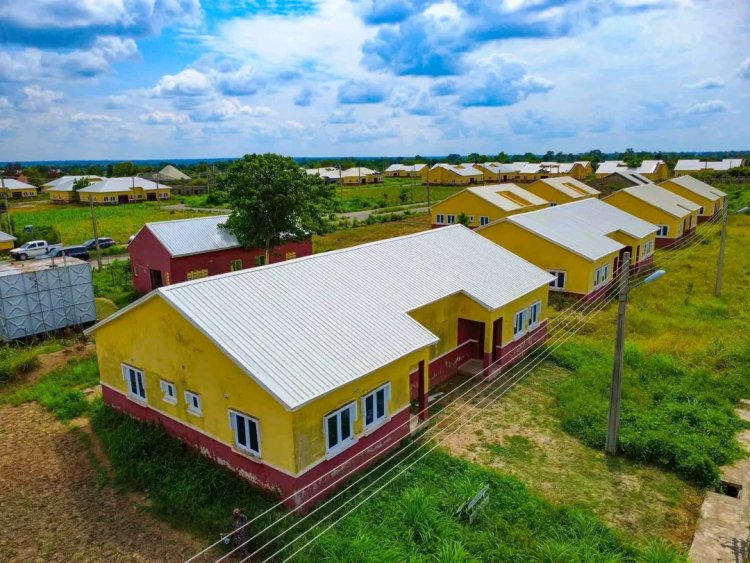
The Group Managing Director of the Benue Investment and Property Company Limited, Dr. Raymond Asemakaha, has announced the sale of intention forms for the 116 unit Agbogbo Ode Housing Estate in Makurdi. He credits the acquisition to the initiative of Governor Hyacinth Alia and presents it as proof of the Governor's commitment to affordable housing. Providing affordable accommodation is a legitimate duty of government. But the public is being given forms, prices and payment plans when what it is owed is an explanation of how these houses came under BIPC's control.
Start with the basic question. What exactly was the Governor's initiative, and what did it cost the Benue State Government? On 11 March 2026, the Federal Ministry of Information reported that the estate was built under the Federal Government's National Housing Programme through the Federal Ministry of Housing and Urban Development. During his inspection, Governor Alia commended the Federal Government for the project and said his administration was exploring collaboration with the Federal Mortgage Bank of Nigeria to finance mortgages for beneficiaries. Nobody claimed then that the state had built the houses.
On 1 July 2026, the same ministry reported that BIPC had taken over the 116 units from the Federal Ministry of Housing and Urban Development on behalf of the state. Dr. Asemakaha said the acquisition followed the Governor's directive to widen access to affordable housing after concerns over the cost of houses at Benue Eco City Estate. If a directive produced this acquisition, what were its terms? Did the state buy the houses outright? At what price, paid to whom, and from what source? Was there an independent valuation? Did the money come from the state budget or from BIPC's own resources? These are ordinary questions for a deal involving 116 public properties. The government should publish the acquisition agreement, the valuation report and the evidence of payment. A Governor's directive can start a transaction, but it cannot replace accountability for public money.
The Commissioners' Quarters in Makurdi make the concern sharper. On 17 November 2023, the then Commissioner for Works and Housing, Tiza Isaac Imojime, called the quarters uninhabitable and said renovation had begun through direct labour. On 15 April 2026, the Federal Information Centre reported that Governor Alia inspected the ongoing reconstruction and ordered the contractor to speed up. Today, the status of that project is still unclear. What was the original budget, and how much has been released and spent? How many units are complete? Why are some commissioners reportedly still in rented apartments, while completed or renovated quarters are said to be occupied by people who are not commissioners? If that is true, who authorised the allocations, and on what criteria? Public residential property should never become a personal privilege handed out without procedure.
This is why Agbogbo Ode deserves close watching. If government quarters can reportedly go to people outside the intended category while the intended officials pay rent elsewhere, what assurance does BIPC offer that these 116 houses will not become souvenirs for political associates and friends of the administration? The announcement promises 40 per cent for civil servants, 40 per cent for the masses and 20 per cent for businessmen. Who will enforce that split? Who will sit on the allocation committee, and who approves the final list? Will BIPC publish the names of successful applicants and their categories? Will there be independent verification? These safeguards cannot rest on assurances or the goodwill of individuals. They must be documented and made public before allocation begins.
The number of houses also needs clarity. At the 1 July handover, the GMD reportedly directed that one unit be converted into a Nigerian Police Force outpost to improve security in the estate. If one of the 116 residential units was used, is BIPC now selling 115 houses? Or was the outpost provided separately? It may look minor, but it shows why the public needs a clear inventory of what was acquired, what is kept for public use and what is offered to buyers.
The allocation formula itself has changed. In July, the Federal Ministry of Information reported 40 per cent for civil servants, 40 per cent for the general public and 20 per cent for low income earners. In the 16 November announcement, the 20 per cent has become businessmen. What prompted the change? Were low income earners dropped as a category? Has the Federal Mortgage Bank approved the revised arrangement? If the aim was to help people who cannot afford conventional private housing, why should businessmen now occupy the slot meant for them? BIPC owes applicants an answer, especially because the scheme is being sold as affordable housing for all Benue citizens.
There is nothing wrong with the state acquiring federal housing assets and offering them to its people. If the deal was properly negotiated and the prices are truly affordable, it could give many families a chance to own a home. But public ownership carries public accountability. Citizens should not be asked to pay ₦30,000 for intention forms before they know the financial details of the transaction, the allocation criteria and the protection against favouritism. The monthly repayments, interest rates, length of the rent to own arrangement and the consequences of default must also be published.
Dr. Asemakaha and BIPC should answer these questions before turning the sale of forms into another publicity event. How much did the state pay for the 116 houses? Where is the acquisition agreement? What is the real status of the Commissioners' Quarters, and who lives in the completed units? What guarantees exist that Agbogbo Ode will not be shared out arbitrarily? Governor Alia may claim credit for facilitating the acquisition, but the people of Benue keep the right to scrutinise the deal and the distribution of its benefits. Acquiring 116 houses is only an announcement. Transparent acquisition, accountable management and fair allocation are the real test of public housing policy.