BENUE'S BUREAU OF ENTREPRENEURSHIP: WHAT EXACTLY IS IT CREATING?
Over ₦776 million allocated, big promises made, but where are the jobs, thriving businesses and evidence of wealth creation? Benue’s Bureau of Entrepreneurship and Wealth Creation must explain what it has achieved, while Governor Hyacinth Alia owes the public answers about the fate of the Benue Tech Skills Programme and its promise of more than 50,000 jobs. Is this bureau creating wealth or merely consuming public funds? Benue deserves results, not expensive government offices hiding behind impressive titles.
By Aondoakaa Tersugh Daniel, 27/10/2026
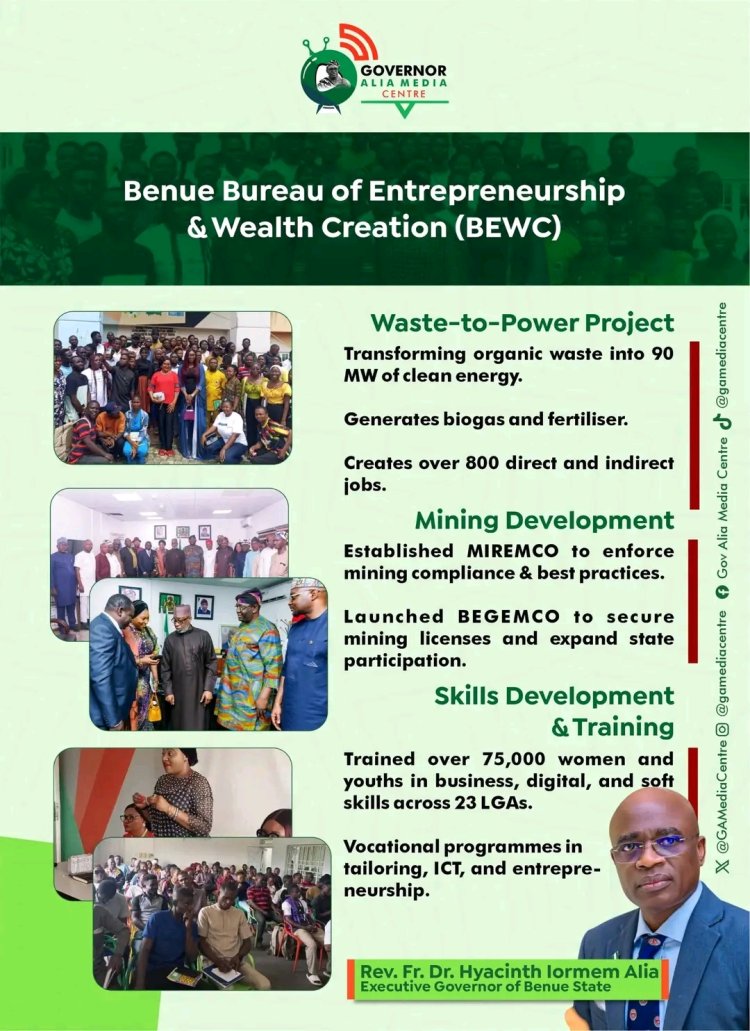
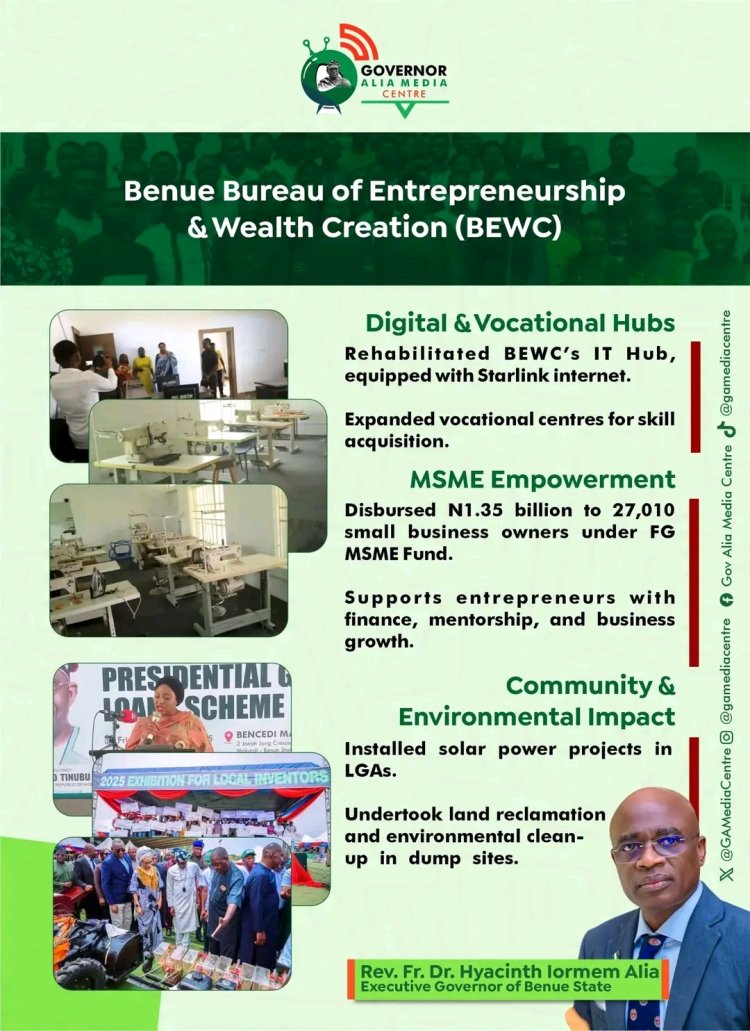
If any institution under Governor Hyacinth Iormem Alia must justify its existence with results, it is the Bureau of Entrepreneurship and Wealth Creation. The name promises enterprise, jobs, innovation and wealth. Its mandate covers entrepreneurship training, skills acquisition, business empowerment, support for small and medium scale enterprises, investment partnerships and wealth creation policies. Yet Benue already has ministries for commerce, trade, industries, and science and technology. So what has this bureau added that the people can see?
The 2026 budget gives it over ₦776 million. Thousands of young people in this state cannot find work, and small businesses are struggling to survive. Spending that kind of public money on an institution that cannot show its impact is a scandal in the making. What was the money used for, and what did Benue people get in return?
Look at the Benue Tech Skills Programme. In May 2024, the Alia administration announced that it would train 10,000 youths in digital skills and information and communication technology. It claimed the programme would create more than 50,000 jobs. Its lead consultant, Jeffrey Udende, told the public that this was not about handing out certificates, and that graduates who remained jobless would be given employment opportunities.
That was a heavy promise, made loudly. The programme was sold as more than lessons in coding, cybersecurity, digital marketing and data analytics. It was supposed to lead to real jobs, real businesses and real livelihoods. More than two years on, where are they?
How many of the 10,000 completed the training? How many got jobs, and how many received support to start businesses that can survive? Where are the 50,000 jobs? Until the government produces verifiable numbers, nobody should accept training sessions and certificates as proof of economic transformation.
There is also the question of who owns the programme. If the bureau is responsible for entrepreneurship training, skills acquisition, empowerment and job creation, what role did it play in Benue Tech Skills? Did it implement the programme, or did another agency take charge? The administration must say which institution is accountable for tracking beneficiaries and measuring employment outcomes.
The bureau's own published mandate makes the demand unavoidable. It lists entrepreneurship programmes, skills acquisition, empowerment, support for small businesses, partnerships and wealth creation policies. Existing ministries and agencies already carry responsibilities in commerce, industry, science and technology. That is duplication, and it is a waste of public funds, just as we have seen with the Bureau of Special Projects and Infrastructure and the Bureau for Solid Minerals.
Benue cannot run a system in which several institutions chase the same objectives while nobody is answerable for results. If the bureau sits at the centre of the state's entrepreneurship agenda, its leadership should be able to point to documented programmes, businesses it has supported, jobs it has created and income it has generated. If they cannot, then what are they doing in office?
That is why the ₦776 million matters so much. What did it fund, and which results can be traced to it? The public is entitled to a clear breakdown showing how much went to programmes, business support, administration and other activities, together with evidence of the benefits delivered.
Governor Alia must order the bureau to publish its expenditure and performance records. His administration must also account for the Benue Tech Skills Programme, including the promised move from training to employment and the projected 50,000 jobs. These promises were made in the name of public service, and the people have every right to know whether they were kept.
Announcements, workshops, certificates and photographs are not economic transformation. Training is only the first step. What counts is what comes after: jobs, viable businesses, better incomes and sustainable livelihoods. A programme is not a success because people attended classes and collected certificates.
The real question is whether this bureau has achieved anything that existing ministries and agencies could not have achieved. If its contribution cannot be told apart from theirs, the administration must explain why it was created and why it still deserves funding.
Benue needs institutions that create opportunities, not offices with impressive titles. It needs entrepreneurs running working businesses, young people earning real incomes, small enterprises growing and jobs coming from productive investment.
Over ₦776 million is far too much public money to spend without a clear account of what it has achieved. The bureau must show how its resources are becoming businesses, jobs and livelihoods. If it cannot, Governor Alia must explain why Benue should keep paying for an institution whose promise of wealth creation has produced nothing the public can verify.