THE PRESIDENTIAL CAMPAIGN IS NOT ALIA'S PERSONAL CAMPAIGN
The new APC Presidential Campaign Council guidelines expose the gap between President Tinubu's national campaign and Governor Hyacinth Alia's reelection ambitions. With Benue's federal appointees largely aligned with Senator Akume, and Austin Agada openly distancing himself from Alia's second-term bid, the governor cannot assume automatic support from the President's political machinery. His earlier disagreement with Tinubu's reconciliation formula and the controversy over parallel primaries further complicate matters. So why is Alia branding his campaign Tinubu/Alia 2027 when the President's campaign is a separate political undertaking? Tinubu's reelection is not Alia's personal campaign.
By Aondoakaa Tersugh Daniel, 04/11/2026
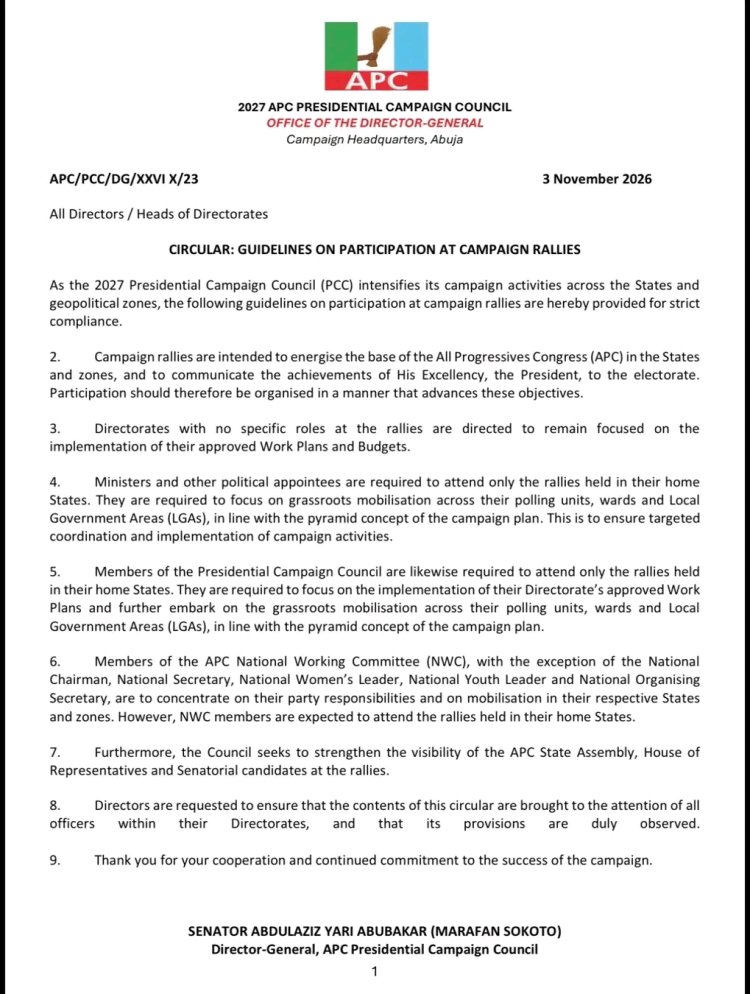
On November 3, 2026, the Director General of the APC Presidential Campaign Council, Senator Abdulaziz Yari Abubakar, issued a circular. Read quickly, it looks like routine administration. Read carefully, it speaks directly to the expectations Governor Hyacinth Alia may have placed on the national campaign machinery.
This matters because Alia has chosen to brand his reelection project the Tinubu/Alia 2027 Campaign Council. The circular suggests that the President's campaign and the governor's campaign are not the same thing.
Paragraphs 4 and 5 are the place to start. Ministers, political appointees and members of the Presidential Campaign Council are to attend rallies only in their home states. They are also to focus on mobilising their polling units, wards and local government areas. The national campaign is not meant to become a travelling entourage for the interests of individual states. Alia cannot assume that federal appointees will show up in Benue to reinforce his reelection bid.
In Benue, that assumption is even weaker. The Minister and many federal appointees from the state belong to the political establishment around Senator George Akume, and their relationship with the governor has been anything but warm. Comrade Austin Agada, himself a Tinubu appointee and a major player in the Benue APC crisis, has openly separated two things: supporting Tinubu's reelection and supporting Alia's second term. Loyalty to the President does not automatically become loyalty to the governor.
The President has also been clear about his own movements. At the inauguration of the Presidential Campaign Council on October 14, he said he would not accompany the campaign team to every state, citing the demands of governance and the country's financial obligations. Specific states were later identified for his personal appearances. Benue was not among them. That does not mean Benue has been abandoned, and an APC presidential rally may well hold here. It does mean Alia should not build his calculations on the presence of the President.
Paragraph 7 is even more telling. In listing the candidates whose visibility the Council intends to boost, it names those for the State House of Assembly, the House of Representatives and the Senate. Governorship candidates are missing. Whether that is deliberate or simply a division of labour between national and state structures, the signal is plain. Governors should not presume they sit at the centre of the presidential campaign.
All of this is uncomfortable for Alia because of how the Benue APC reconciliation went. President Tinubu stepped in to restore cohesion through an agreed working arrangement. At the May 3 meeting, Senator Akume announced that the understanding included automatic return tickets for serving elected officeholders, from the governor to members of the National and State Assemblies. Alia publicly rejected that reading and insisted that nobody had an automatic ticket. That was no small misunderstanding. It revealed a deep gap between the presidential formula for peace and the governor's own idea of how the party's future should be run.
The primaries made matters worse. Parallel exercises were held, and candidates emerged outside the arrangement announced at the reconciliation meeting. It took the party's National Appeal Committee to sort out the disputed outcomes. One must ask how faithfully the governor honoured the spirit of the President's intervention. A leader who quarrels with an arrangement meant to reconcile his party cannot expect the quarrels to vanish because a presidential election is approaching.
Which brings me to the name itself. What is the logic of presenting the President's reelection and the governor's second term as one indivisible project? Nigeria runs presidential and governorship elections on different dates, under different campaign arrangements. Tinubu has a national organisation with its own Director General, directorates, budgets and guidelines. Alia has a governorship contest of his own to fight. Why should he borrow the President's campaign identity and dress his personal ambition as an extension of the presidential project? The November 3 circular makes the separation clearer still.
The Benue Strategic Alliance for Tinubu 2027 shows how this plays out on the ground. It has publicly distanced itself from the campaign council announced by the Alia faction. Its commitment, it says, is to the reelection of President Tinubu and to legislative candidates recognised by its leadership. Agada has made his own position on Alia's reelection known. These are not small signals. People can back the President without accepting the governor's leadership or his second term. Putting two names on one banner cannot manufacture unity, and it cannot transfer presidential goodwill by itself.
Alia must understand this. The presidential campaign is not his personal campaign, and the President's priorities cannot be shrunk to fit the governor's reelection arithmetic. Tinubu needs a coordinated national structure that can sell his administration's record and mobilise voters across the country. He does not need that machinery turned into a tool for settling the internal quarrels of the Benue APC.
Alia's governorship campaign belongs to his own political structure. Its strength must be proven on its own merits, not borrowed from the President's national standing.
So the November 3 circular should be read alongside the unresolved questions of the reconciliation, the disputes over candidate selection, and the refusal of key stakeholders to be absorbed into Alia's campaign arrangement. The President has set the framework for his national campaign. The question is whether the governor has grasped the difference between campaigning for Tinubu and campaigning for himself.
A shared party platform does not mean shared political interests. A joint campaign title is no substitute for real reconciliation. Tinubu's reelection is a national undertaking. Alia's is a separate contest. The governor must not mistake one for the other.