SUPPORT GROUPS EVERYWHERE, BUT WHERE IS ALIA’S CAMPAIGN COUNCIL?
By Aondoakaa Tersugh Daniel, 20/10/2026
There was a political episode in Kwande's history when the chant, “Ashongo kaa er i er nyii? Igboo iywa anyi!” filled the air. It was a ruthless moment, arguably more ruthless than the chant of “No Lalia, No Benue.” At the time, Hon. Adzu Timothy, the current Chairman of Ushongo LGA, was probably still a boy and may have missed the episode. Perhaps he would like to see it replayed. But Hon. Adzua Ashongo is still very much alive and should not be pushed into issuing that order one more time.
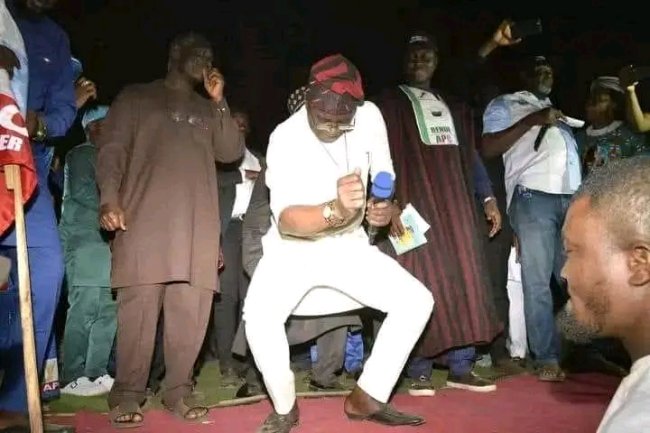
Governor Hyacinth Alia inaugurated support groups yesterday for his 2027 reelection bid. The campaign council everyone is waiting for is still nowhere to be seen.
The PDP, ADC and NDC have already named theirs. Alia, meanwhile, goes from one support group to the next without showing us the team that will actually run the project. So the question is no longer how many groups he can inaugurate. It is whether he still has the relationships and trusted allies to build a formidable campaign team. Or is the delay hiding something his handlers would rather we didn't see?
Look at President Bola Ahmed Tinubu. After winning in 2023, he retained many of the people who delivered that victory and expanded the tent to bring in more interests. He has leaned on established machinery instead of making every state rally depend on his own presence. Tinubu knows elections are won by structures, relationships and people who can deliver their own territories. He did not act as if those who worked for him in 2023 had suddenly stopped mattering.
Alia's case looks very different. He has fallen out with several of the figures who helped him win in 2023. The people whose influence, party structures and networks produced his emergence are no longer necessarily on the same page with him. So who forms the nucleus of the 2027 campaign council? Is that why the list is taking so long? Or is the governor struggling to accept that many of those who delivered his first victory may not be available for a second?
Remember that the 2023 APC campaign council in Benue was no small gathering. Senator George Akume was chairman, with the late Chief Audu Ogbeh as deputy. Paul Biam was secretary and Ambassador Philip Eche his deputy. Reverend Frederick Ikyaan served as Director General, with Jacob Obande as deputy. The list also included Comrd Austin Agada, APC state chairman, Senator Tilley Gyado, former Deputy Governor Stephen Lawani, Patricia Kupchi and Kate Nomhwange. These were the people trusted to coordinate the campaign that brought Alia and Sam Ode to power, backed by wider party mobilisation.
So where are they now? Who among them is still close enough to the governor to hold a strategic seat in his reelection campaign? Who has been retained, who has been dropped, and who has walked away? Which new heavyweights have come in to fill the gaps? These are not small questions. They tell us whether Alia's reelection rests on a working political structure or on the hope that inaugurating groups with his name is proof of readiness.
Of course, someone will say the governor is simply taking his time to assemble an extraordinary team. Benue people have reason to doubt that. We have seen this film before, with his executive council. Other governors had completed their cabinets while Alia was still deliberating. When the list finally came, it set no great precedent. After a reshuffle, more than half of the original team was gone. The long wait did not give us a settled, enduring council. Why should a delayed campaign council be any different?
The pattern is hard to miss. First a long wait for appointments, then changes that unsettle the very structure so carefully put together. Now another long wait, this time for the campaign council, while support group inaugurations roll on. Sometimes a long wait produces an outstanding result. Sometimes it only delays the discovery that nothing extraordinary was being prepared.
Perhaps the most embarrassing possibility for Alia is that announcing the council would force him to face a reality the inaugurations can hide for now. He may have enthusiastic individuals ready to declare support. What a campaign needs are established political figures whose networks and experience can be turned into a coherent machine. A long list of associations cannot replace influential party stakeholders, and a string of public events cannot undo political estrangement. If that is the real reason for the delay, it would mean the very people whose capital carried him to Government House are the ones whose absence is now hard to explain.
That is what makes the contrast with Tinubu so striking. One man retained the machinery that delivered his first victory, kept experienced hands and expanded the structure for another contest. The other is inaugurating support groups and leaving the public guessing who sits at the top. The difference is not just about when announcements are made. It is about whether the relationships that delivered the first victory are still there for the next campaign.
At this point, the missing council is more than a scheduling matter. It offers a window into the state of Alia's political relationships ahead of 2027. He may keep inaugurating groups, but the public will keep asking who is directing the operation, which experienced figures are involved, and what has become of the coalition that won in 2023. If it is only a matter of timing, the eventual announcement will settle it. If it reflects a deeper difficulty in assembling a trusted team, no number of inaugurations can hide that for long.
The greatest irony would be for a governor who rode to power on the strength of a formidable political coalition in 2023 to approach 2027 with support groups bearing his name but without the depth of political relationships that secured his first victory. Perhaps, in this unfolding drama, lies the true meaning of “Se tese ve mkposo.”