WHEN POLITICAL CRAFTSMEN BECOME DEPENDANTS OF INCUMBENTS
Senator George Akume's political survival has never depended on a governor's second-term ambition. From the 2003 election to the 2027 political calculations, his record contrasts sharply with Chief Barnabas Gemade and Chief Gabriel Suswam, whose political fortunes have repeatedly intersected with incumbent governors' re-election bids. Gemade's claim to possess the craftsmanship of securing second-term victories raises an uncomfortable historical question: where was that craftsmanship when Akume needed re-election in 2003? Who really needs a governor to remain politically relevant?
By Aondoakaa Tersugh Daniel, 06/11/2026
Senator Dr George Akume has never hidden behind an incumbent governor's second term to secure his political survival. His record shows that his relevance does not depend on who occupies Government House, or on whether the occupant wins another term. Whatever role he played in the emergence of a governor, Akume has always stood on his own feet and pursued his own ambitions.
The same cannot be said of some politicians in Benue. Their survival appears tied to the second term ambitions of incumbent governors, and once that cover disappears, their fortunes suffer. Chief Engr. Barnabas Gemade and Chief Gabriel Suswam readily come to mind.
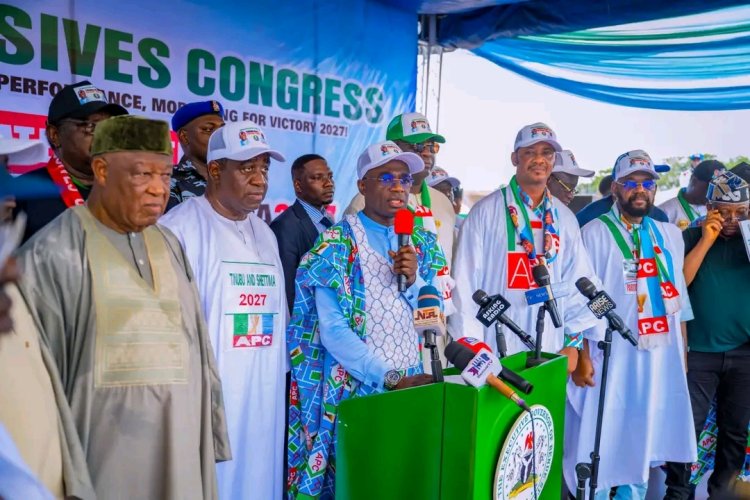
At the inauguration of the Alia 2027 campaign team yesterday, Chief Gemade, whom Akume described as a cheerleader at the funeral of the late Wanteregh Paul Unongo, made a revealing declaration. He said that "those who have the craftsmanship of making sure that governors are re-elected are still alive and they are here." That claim deserves to be tested against the record, starting with Gemade's own conduct.
In 2003, Akume sought re-election as governor. If Gemade truly had the craftsmanship of delivering second terms, that was his chance to prove it. Instead, he led the opposition against Akume, first backing Chief Mike Mku under the UNPP and then abandoning him for Chief Paul Unongo of the ANPP. The contest was fierce, yet Akume prevailed. He won his second term without the help of the same craftsmen who now present themselves as indispensable.
The 2011 election tells a similar story. Gemade supported Suswam's re-election, and his own senatorial ambition was tied to the governor's fortunes. Akume did the opposite. He stepped aside, contested the senatorial election on the platform of the ACN and won. One politician could stand alone, while the other built his calculations around an incumbent's second term.
Then came 2019. Gemade sought a return to the Senate on the platform of the SDP while Chief Samuel Ortom fought for re-election, and the supposed craftsmanship did nothing for him. He finished a distant third. Suswam, on the other hand, won his senatorial seat on the PDP platform while Ortom was seeking another term. Suswam pursued his ambition within the environment of an incumbent's re-election, while Gemade could not turn his political standing into an independent victory.
Today, both men are again seeking relevance inside an incumbent's second term project. Their alignment with Alia's reelection raises a fair question: what independent political strength do they actually bring? Their setbacks outside the protection of incumbent structures make Gemade's boast all the more interesting. They may resent being called political dependants, but Akume would simply call them cheerleaders. The difference is not a matter of vocabulary. It is a matter of who can survive without leaning on another politician's fortunes.
Akume's record tells a different story. He won re-election in 2003 without Gemade. He won the 2007 senatorial election and went on to win again in 2011 and 2015, none of it dependent on the second term ambition of an incumbent governor. In 2019, he needed no governor's platform to remain relevant, and he became a Minister of the Federal Republic of Nigeria. Was it Gemade who nominated him for that appointment? Even in the unfolding calculations for 2027, Akume is not relying on Alia's reelection to preserve his relevance.
Suswam's alignment with Alia's second term project also deserves scrutiny. Beyond whatever calculations he may have, his personal ambition suffered a major setback after the intervention of the APC National Appeal Committee. Is his commitment to Alia's re-election entirely about the governor's performance, or is he also searching for another platform through which to pursue his own ambition?
There is also a question Gemade must answer. He has repeatedly claimed that he nominated Akume for the governorship of Benue State. How did Akume emerge as the preferred choice for that ticket, and what considerations informed it? If Gemade was truly instrumental in making Akume governor, why did he later back Chief Mike Mku and Paul Unongo against the same Akume when he sought re-election in 2003?
The real difference between Akume and the cheerleaders is simple. Akume has never needed a governor's second term to stay politically relevant. He has contested, won and risen through different platforms without making his survival depend on the fortunes of a sitting governor. Gemade and Suswam may have their own versions of political history, but Gemade's latest declaration has reopened a question their records cannot easily escape. If they are the craftsmen who make governors win second terms, who makes them politically relevant when those governors are no longer seeking re-election?